Chanin Polpanumas
CONTEXTUAL ANALYSIS
Inspiration
The inspiration for making this set of ivory came from my being ordained as a monk throughout the rainy season. Then there is chaos outside various chaos. When I came to try to explore my mind, it was as chaotic as outside things. Therefore, I understand more that the suffering that we are experiencing is just that difficult.
We have experienced suffering since childhood until now. We seek a way to end suffering, which the Lord Buddha said since thousand years ago. I will give a simple example of how to end suffering first. For instance, If you are angry with someone, but they do not know or know. You get to suffer already; however, they don't attend to you anymore. So you make your emotion, you should be conscious and eliminate it. As if you let go of the stone, you will be happy with your life. The person who holds the stone is always heavy and tired. It does not take someone who does not hold anything to be satisfied.
Mapping
Book Reference


It begins with introducing the knowledge gained from Dharma practice that explores one's mind as the core. Furthermore, read books such as Sapiens that refer to the human history of humanity or Ikigai, the Japanese philosophy of happiness, and The World as Will and Representation, which discusses the philosophy of the East to the West. The first book examines the history of the conclusion that Humans want to make themselves, their families, and their friends happy. Second is Ikigai, a life-balance adjustment that brings happiness based on Japanese philosophy. The third is Roland Barthes's mythologies which are interpreted through cultural beliefs. However, it is concealed to be perceived as if it were nature. Myths work by understanding to overwhelm the sensory and utilitarian meaning of things and give them a new level of meaning, which is valued and ideologically meaningful. Fourth, Wabi Sabi is a Japanese philosophy that embraces the imperfections, blemishes, and traces of the time-changing nature of everything. It is rooted in the understanding of the nature of Zen Buddhism.
Finally, book, the writer(Arthur Schopenhauer) studied the philosophy of Buddhism in India. He said that what causes suffering is love. Therefore, if one wants to be free from suffering, there are two things; one is becoming a monk, and the other is going to see the garden or go to the movies.
Artists Reference


I start with interested artists. The first artist is Natee Utarit, a Thai artist who talks about what would happen if Buddhism spread to Western culture. His work made me rethink what would happen if Buddhism appeared in Western culture. The results are excellent. He started with an exchange at Maple City in Italy. Then he came across a statue of that era, similar to the Buddha image in Thailand, causing him to question the above. It made me want to try Eastern symbolism for the audience. Although I may have yet to succeed, I have already tried.
Second, a Thai director (Apichatpong Weerasethakul) uses a simple technique to reflect plastic. When I first saw this work, I wondered how to do it. However, the artist will answer on the back when I keep watching. I feel sublime. Then, I want to continue to experiment and develop works by exploring new possibilities. Furthermore, the artist's use of exciting signs, such as making a fire, is linked to granny, who appears to use CG. Because the work is a video, the context of the shooting area and the environment's sound is rural. There is some harmony between the local context and the internal state of Buddhism.
If you want to watch it, you can click on this link
(https://www.youtube.com/watch?v=8Hk4zepxyoE&t=1s).
Finally, an artist named Ingrid Weyland used landscapes with crumpled paper or burned and re-shot them. I have not yet seen the actual work. However, I got to know her work through the Lenculture contest, which annually selects the works of interesting photographic artists for which she won the prize. When I look at her work, it reminds me of the experimental work done during my undergraduate years when I was only making teacher submissions. Nowadays, such techniques are interesting because they are visually simple but surreal in their work. I have a particular preference for things that make ordinary photos use simple techniques to enhance the work to make it more interesting.
Outline of my practice
I am interested in photography (pictures), and actual items pique my curiosity (materials). It is because they are related to the image's meaning somehow. As a result, the dimension of vision and reality is a Buddhist idea for thinking about the inside and outside of the mind.
Context of my work

The middle way, 2022
Technique: Digital print on paper
Size of each piece: 24 x 34 cm.
Size: 38 x 75 cm.
When the Buddha was practicing all his actions, he was skinny. The Phra Indra brought the mandolin, which looks like a guitar but has three strings. He played this instrument which played the harp that was too tight, the strings would break or be too loose, and the harp's sound would not be musical. However, when he adjusts the lines to fit, the sound will be beautiful.
So just like life, being too extreme is not good, and being too loose is not good. So, the Buddha always said that the middle way is good. Not sober mind, it is not too light, so it is suitable for entering into the state of Dharma to attain the path and nirvana.

The light of the Dharma, 2022
Technique: Digital print on paper
Size: 46 x 61 cm.
Light is one of the religions that represents goodness. The Buddha's hand emitted a dharma light, like teaching the Dharma to all human beings suffering from suffering. The Buddha wanted people to be free from suffering. But it depends on whether that person can follow according to the factors of each person's karma.

The lotus flower of hope, 2022
Technique: Digital print on paper
Size of each piece: 24 x 34 cm.
Size: 38 x 75 cm.
The lotus flower in the east represents the Buddha, who is an enlightened and awakened one who understands the truth of nature in the cycle of consciousness. Everything is governed by natural law (formed, existed, then disappeared) that is perishable. Human life is short. As the last sermon says, "All conditioned things undergo changes. Decay is a normal process. All of you must not be reckless. You must hurry to find your refuge."
Context
Srinivas Surti Seminar
10/10/22
Room C134


In my classroom, there are seminars from outside artists to lecture and include simulations of installation works on what this type of installation means. I will start with a lecture where he describes artist statements, processes, inspirations, references, philosophy, etc. These things made me rethink my works that will be further developed into works. Moreover, the development of the work from viewing the reflection of the work to be developed into a new set of works continuously.
In the second part of the seminar, Srinivas Surti came to the classroom to critique the work. Let me describe the concept of installing it on the wall, such as why it has to be installed like this, how I feel, why this image has to be said here, and so on. From analyzing and arguing, I have refined the reasons to support each piece of work, content, and symbolism, as well as listening to my classmates and artists criticizing my works, gaining new knowledge from this seminar. Then I listened to my classmates' works to clarify and express their opinions in our way because there is no right or wrong in art.
Therefore, this seminar learned the artist's working process, the installation of the works, and the comments from classmates and artists so that I could develop my works even better.
Benjamin Jones/ Stephan Keppel
18/10/22
The Koppel Project Hive

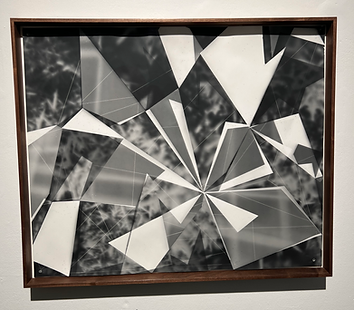

On that day, The Koppel Project Hive hosted an outdoor show by artist Benjamin Jones/Stephan Keppel. Through photography, the exhibition explores familiarity and memory.
This exhibition can give me many ideas. For example, the first story has complex content. However, when I listened to it, I understood more. For instance, the selection of tree symbols and greenhouse forms all fit together.
Secondly, picking up objects to be photographed is relevant to the subject matter. The third issue is the selection of works that are appropriate in the context of the area. Finally, a highly experimental technique produces new results. However, However, if I had not listened to the artist's lectures, I would have been skeptical of the work, and it might have made me feel indifferent to this exhibition.
Visiting an exhibition outside this place opens the experience of seeing to understand the concept and the context of the area of interest. For example, the room on the south floor where the sound of trains passing by makes the sound reverberate, corresponding to the prints covering one side of the wall or the film collages with both shadow and installation techniques.
Workshop Large printing with Josef Konczak
10/11/22
At C134


In this workshop, I learned many things from Josef in two ways in the morning. First, he talked about real-size printing and the use of large-format printers.
Firstly, Josef taught me how to print the actual size by printing on A3 paper and then printing to the desired size to compare with the actual size. During my undergraduate years, I could only speculate on the extent to which it was represented. Moreover, the process is not as complex as I thought, but it might be a waste of paper and money. However, if I want to be professional, I should do it to see the initial work.
Secondly, that afternoon, he took the students to the printing room, where the staff was stationed and would assist the students who needed to print. However, the printer here is not limited in the width of the print, but it is not an obstacle. Although there are limits on the length of the page, there are many levels of printing paper, matte paper, glossy paper, and specialty paper, all of which produce different colors. Therefore, we must choose the right paper for our work. Before starting the print job, We should print out the samples to see the actual colors on the paper.
In conclusion, this learning is both lectured and practical knowledge that makes me understand various processes in work. I enjoyed it and understood it clearly.